A producer needs one five-second clip from years of footage. An editor is waiting for a high-resolution file to arrive. Marketing has the right asset, but nobody is sure the licence is still valid. IT is paying for several storage tiers and a handful of point tools that each solve part of the problem.
And none of these people are in the same place. Gallup’s latest figures put 52% of remote-capable US employees in hybrid roles and another 26% fully remote. Ericsson reports that video makes up around three quarters of all mobile data traffic. Your contributors are everywhere, on whatever device is in front of them.
That’s usually when the MAM conversation starts, and when someone asks for the ROI.
Here’s my problem with how that question usually gets answered. Most MAM business cases are built for a system that stores media and waits for people to do the work. That model has a particular ROI and a particular way of measuring it. An autonomous MAM is a different animal completely, and if you measure it the old way, you’ll undervalue what matters and you will miss the costs that hurt the business.
The short answer: Build your MAM business case on three things: the platform (where your media lives, how AI is applied and how open the system is), the business model (how you pay as usage grows, and whether AI and renewals hold surprises) and the deployment (how soon real users get value). Then measure technical and operational outcomes, such as time from ingest to searchable, review cycle time, work the system completes without being asked and how much content stays on the governed route, rather than counting logins or hours saved searching.
Era 2 ROI: the business case for a better filing cabinet

I think of media management in three eras. Era 1 was file storage: a place. Era 2 was the traditional MAM: a system, but one that still needs people to feed and maintain it. Era 3 is the autonomous MAM: a system that organizes and acts on its own, within rules you set.
Era 2 had a familiar business case. You counted hours saved searching, storage consolidated and tools retired. You paid a large licence, a migration project and professional services up front, then waited months for go-live. Value arrived only when people did the work inside the system: indexing, filing, chasing versions, checking rights.
It has three weaknesses.
Value is delayed. If deployment takes six months, the first half of the year is pure cost. Early enthusiasm fades while people wait.
Value decays. When indexing slips, search gets worse, people drift back to shared drives, and the ROI you modelled quietly erodes.
Costs grow in ways the model didn’t count. Seat pricing punishes you for inviting reviewers, renewals jump, and AI processing arrives as a surprise on the invoice.
Era 3 ROI: count the work the system takes off people

An autonomous MAM changes what you’re buying. You’re no longer buying a better place to put media. You’re buying work done indexing, filing, versioning, routing, flagging, all without someone having to remember to do it.
That shifts the question from “how much faster can people search?” to “how much routine work does the system complete, how reliably, and how soon?” It also changes the risk. Gartner predicts that over 40% of agentic AI projects will be cancelled by the end of 2027, citing escalating costs, unclear business value or inadequate risk controls. Autonomy without a clear business case and real governance is exactly how that happens.
To be clear about what autonomy means: the AI takes the work, not the job. Creative judgment, storytelling and client relationships stay with your people. The return comes from giving them back the hours they spend on admin.
The three parts of the business case

1. Platform: where the cost and the value are decided
Architecture decides more of your ROI than any feature does.
Where does your media live? If the MAM must copy your library into its own storage before anyone can use it, you pay to move it, pay to store it twice and wait to start. Video makes this expensive fast. An hour of 1080p ProRes 422 HQ, at Apple’s published target rate of about 220 Mbps, is roughly 99 GB. A platform that indexes media where it already lives removes most of that cost and time.
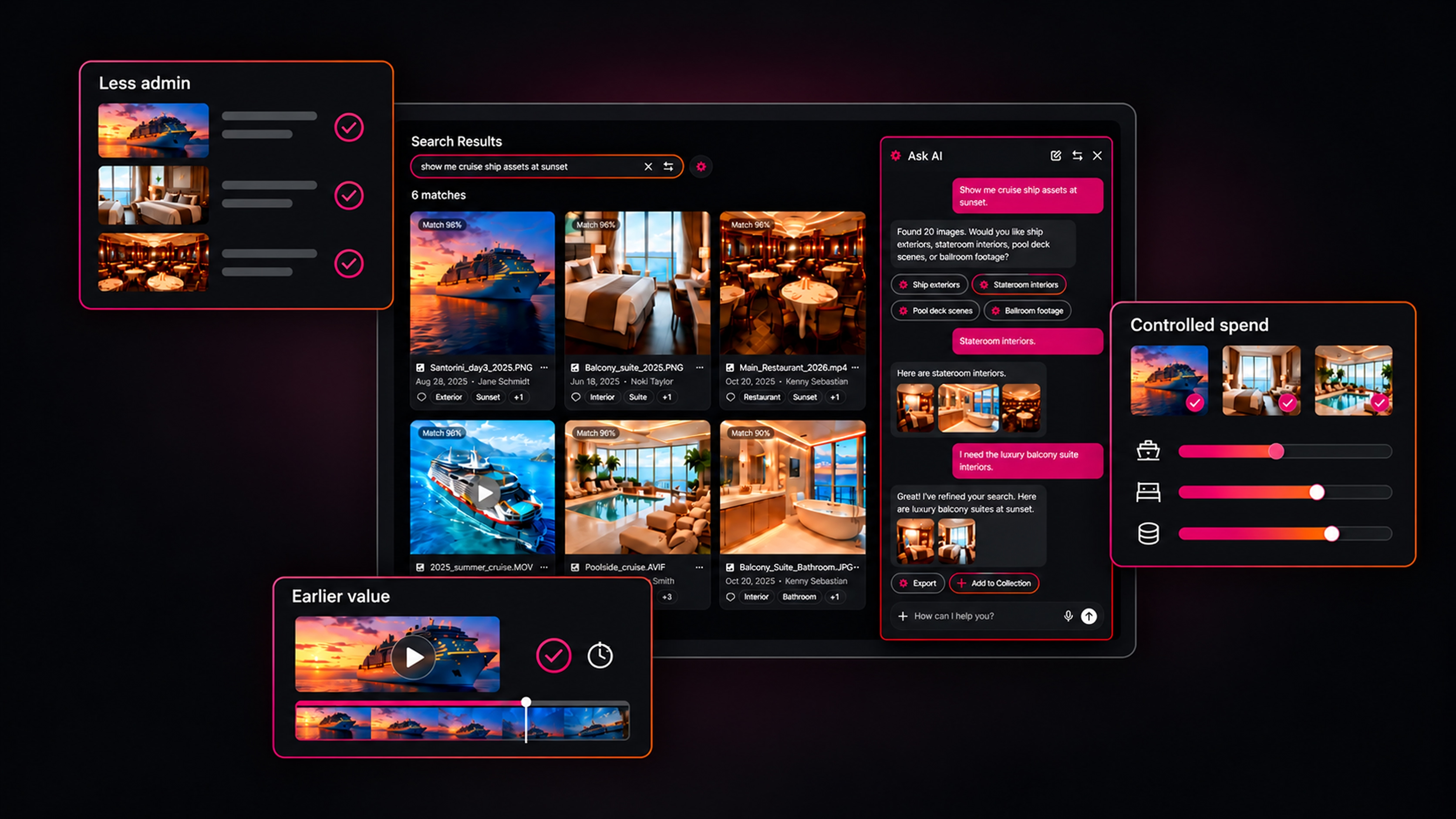
How is AI applied? All-or-nothing AI indexing makes you pay to process footage nobody will ever search. Selective indexing, by collection, folder or file type, lets you spend where the value is. Start by checking whether your media library is ready for AI, then prioritize the collections with a clear use case.
Is it open? An open API lets your existing systems use the same records, so you don’t pay for a new integration project every time the workflow changes.
Is governance built in? In our recent piece on digital asset governance, I argued that trust has to be designed in, not bolted on. That matters even more when the system starts acting on its own. Every automated action should be visible, explainable and reversible.
2. Business model: the costs that never appear in the demo
Put these lines into the model explicitly. They’re where most MAM business cases go wrong.
- Reviewers. What does it cost to add 30 external reviewers for a two-week campaign? If the answer is “30 seats”, expect side-door sharing and lost governance.
- AI usage. What will indexing cost, who controls it, and will you see the cost before a bulk job runs?
- Storage and egress. Are you forced to rent the vendor’s storage? What does it cost to get your media out?
- Year two. What happens to the price at renewal if your footage and your team double?
- Modularity. Can you pay for the capabilities you use, or are you buying a monolith to get the one thing you need?
3. Deployment: time to value is part of ROI
The same annual value is worth much more if it starts sooner. As an illustration, take two systems that deliver identical value once live. One goes live in month 7 and captures half of its first-year value. The other starts delivering in month 1 and captures eleven twelfths. The second delivers nearly twice the first-year return from the same capability.
So ask what has to happen before your first real team can use the system, and expect the answer in weeks, not quarters.
The metrics that matter: technical and operational
Logins and “hours saved searching” are Era 2 measures. These tell you whether an autonomous MAM is actually paying back. Baseline them before you buy, then measure them in the pilot.
Technical
Operational
Use these measures when defining your media asset management requirements, so each shortlisted vendor faces the same tests.
The last four are the ones that separate an autonomous MAM from a traditional one. If the system completes more routine work each month, people correct less of it over time, and admin hours fall, the return is compounding. If not, you’ve bought an Era 2 system with an AI badge.
A model finance will trust
Keep the arithmetic simple and the assumptions visible:
Annual ROI = (annual value created − annualized total cost) ÷ annualized total cost × 100
Value includes recovered staff time, avoided transfers and duplicate storage, retired tools, avoided reshoots or relicensing, faster review and audit effort saved. For example, if 20 people each recover 30 minutes per working day, that’s roughly 2,500 hours a year. Multiply by your own loaded labour cost.
Cost includes everything the business model can add: software, AI usage, storage and egress, reviewer access, implementation and the year-two renewal. Then adjust the first year for when value really starts.
Don’t start with a vendor’s ROI percentage, including ours. Start with your own baseline.
How Evolphin X fits
We built Evolphin X to be an Era 3 MAM, and to make the business case easy to check. Here’s what’s available now and what’s coming.
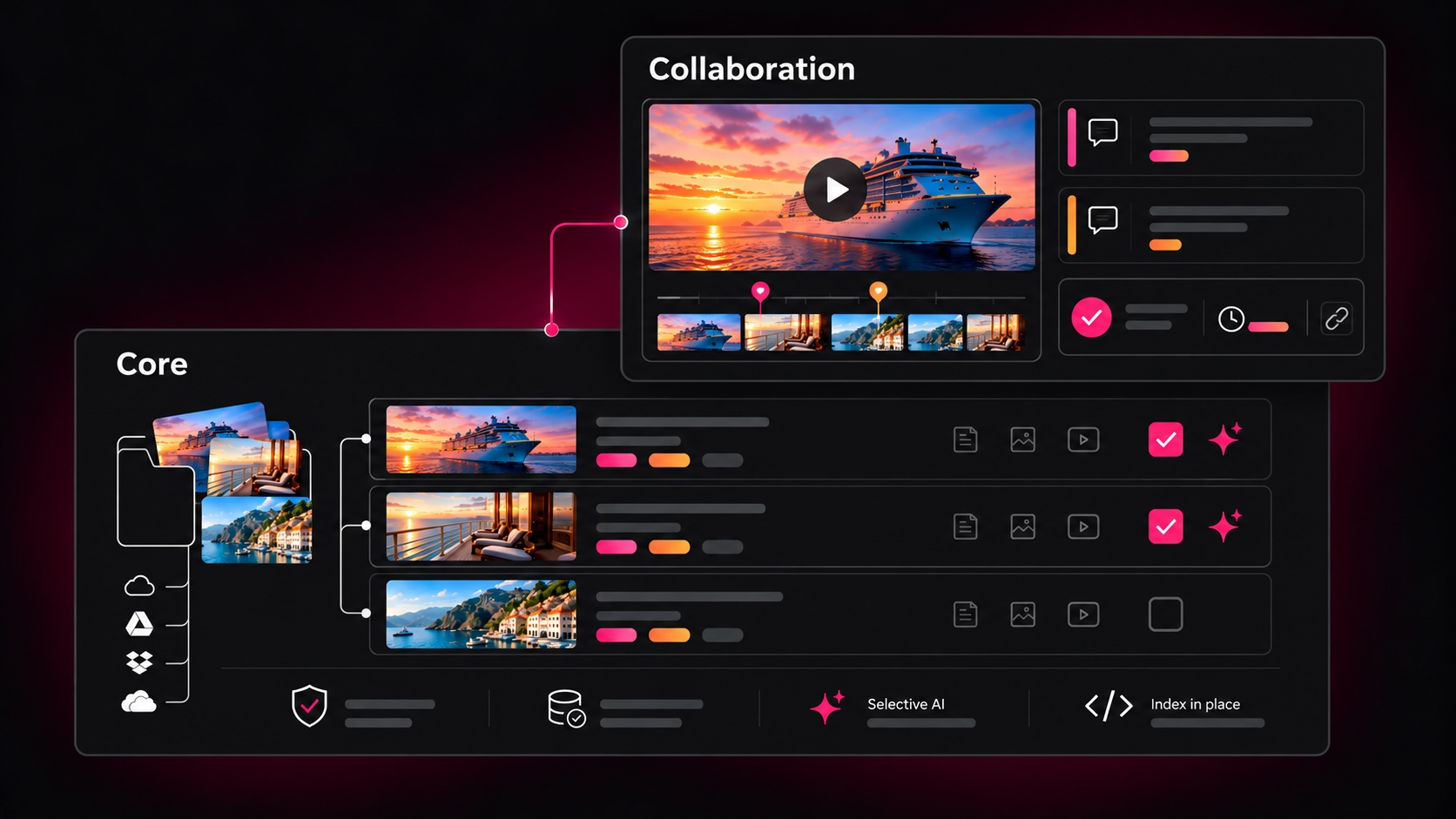
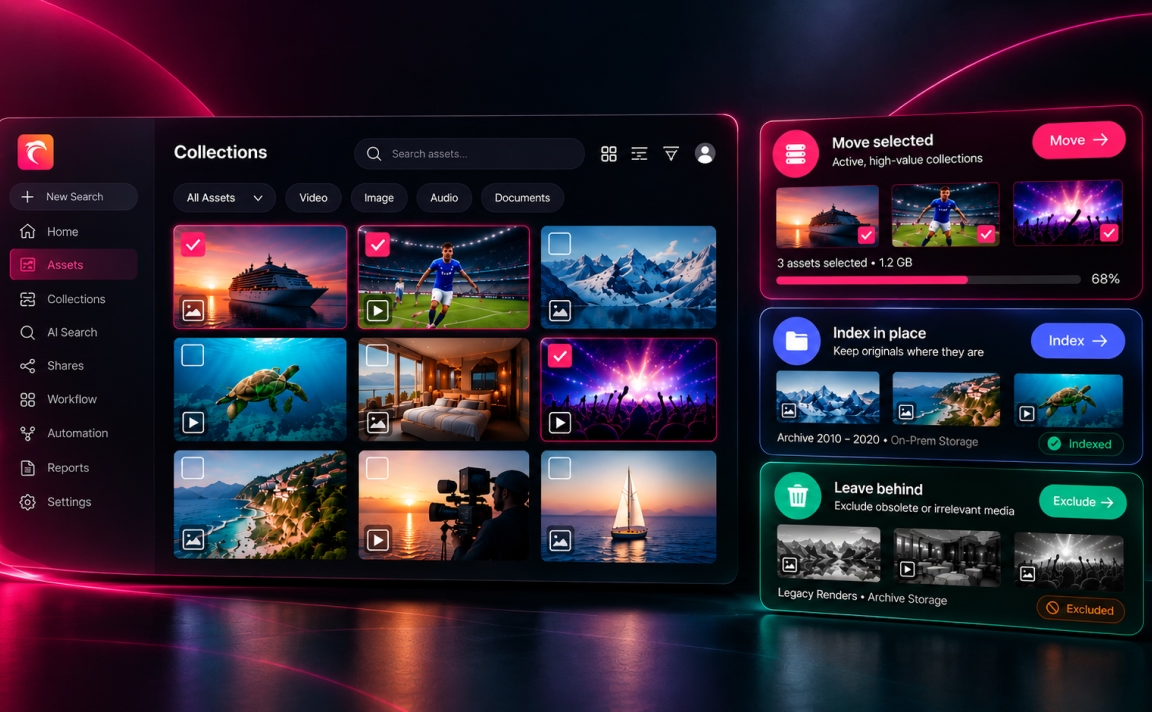
Core is the engine. Every Evolphin X deployment runs on Core. No engine, no car; no Core, no MAM. Core owns access control, data integrity, AI integration and an open API. Index in Place connects to storage you already own, cloud or on-premises, indexes it and keeps the record in sync when files change. Selective AI indexing lets you choose which files, folders or file types get AI processing. When moving content does make sense, Evolphin X can transfer selected collections to new storage. Scheduled reconciliation reports missing originals, and cost warnings appear before bulk AI jobs; both are live and we’re still improving them.
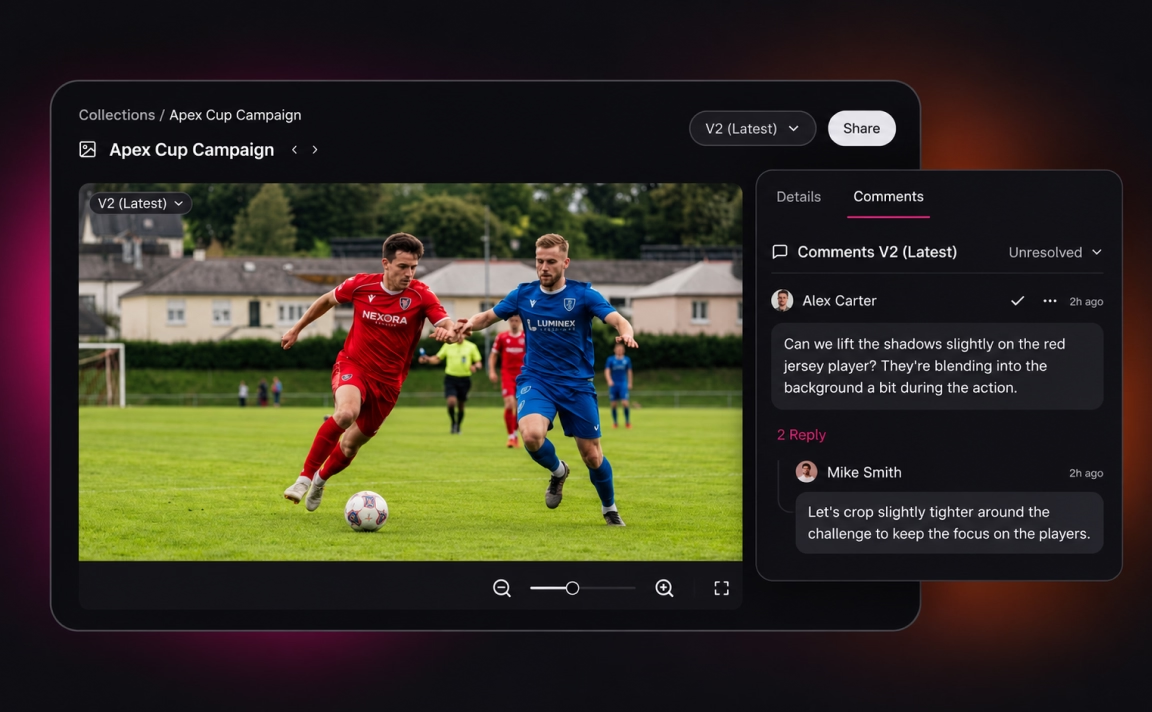
The Collaboration module launched on 1 October. It gives your team, agencies and clients focused, expiring workspaces to comment, approve and upload, without an account and without seeing the rest of your library. That keeps external work on the governed route without a seat for every reviewer.
What’s coming. We’re moving to a model where you can switch on modules yourself and pay for what you use, without a sales negotiation every time your needs change. We’re also building Adobe plugins so editors work with the library from inside their creative tools, Portals in early 2027 so you can share, license or sell content from your own storefront, a Mobile app for teams who don’t work from one place, and Analytics. Over the next year, we’re adding the autonomous capabilities that change the ROI most: automatic tiering, rights and expiry enforcement, workflow routing, derivative generation, and learning from your corrections.
Questions to ask every vendor
- How long from upload to searchable, on our media?
- What happens when files change outside the MAM?
- Can we choose what gets AI indexing, and see the cost first?
- What does it cost to add external reviewers for a short project?
- What will year two cost if our footage and team double?
- What routine work does the system complete without being asked today, and what is roadmap?
- How do we see, correct and reverse what the AI did?
- How soon will our first real team get value?