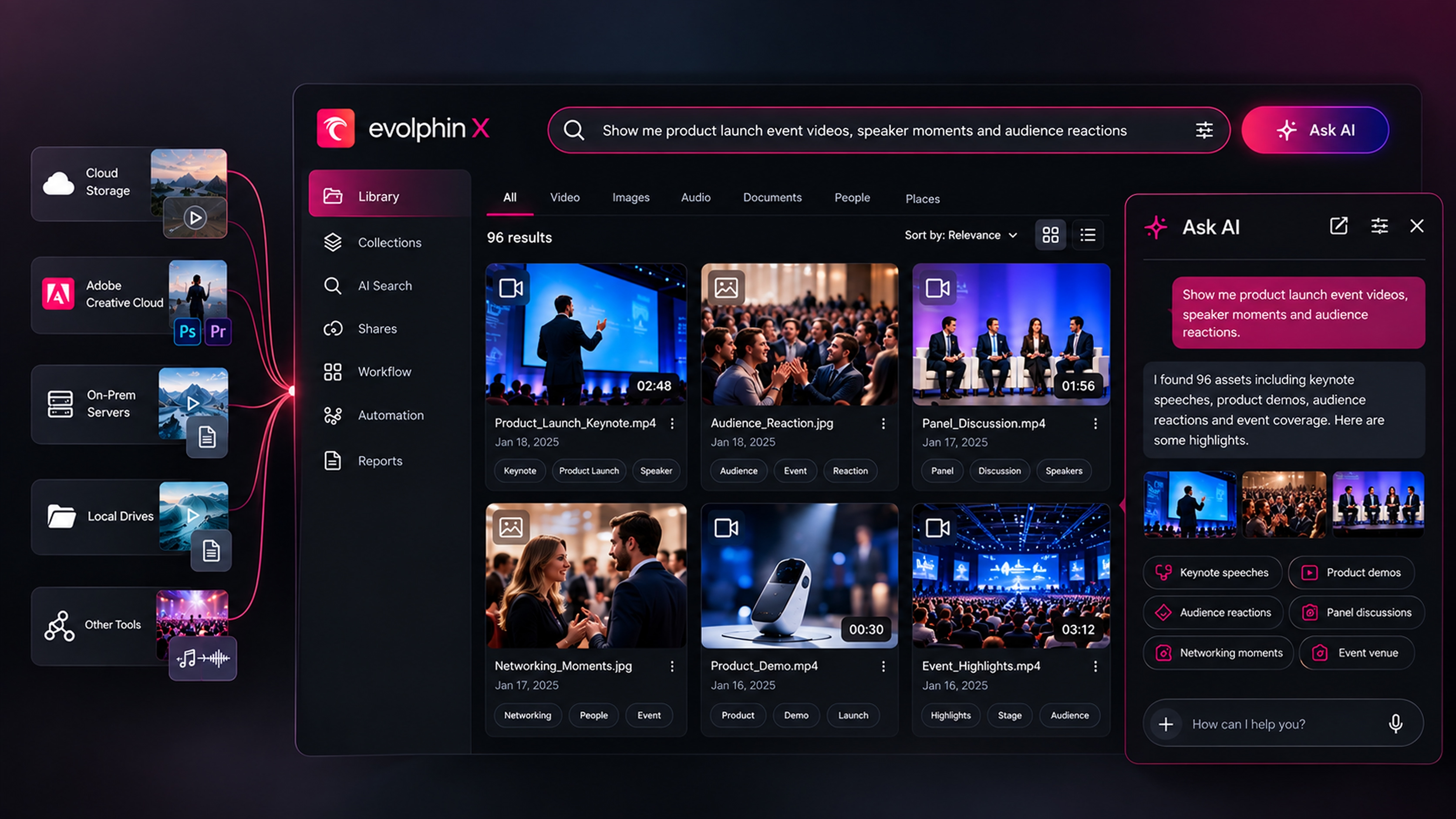

Sit through any DAM or MAM demo this year, and you’ll see the same slide. AI tags everything on the way in. You type a question in plain English, and the right clip appears. It’s impressive, and it’s become the industry’s whole story. In February, G2 looked at ten DAM vendors. Every one of them pointed to AI tagging or semantic search.
Here’s my problem with that story. I think it’s aiming at the wrong goal.
The short answer: AI indexing and LLM search are real progress, but they solve the smallest part of the problem. Finding an asset was never where most of the time went. The work happens after the find: Is this the approved version? Are we cleared to use it? Who needs to sign off? Which formats does each channel need? When does the licence run out? A library that only answers questions still needs people to do all of that. The real change in AI for media asset management comes when the library stops waiting to be asked and starts doing the work.
What the consensus gets right
AI tagging is a big deal. For twenty years, search in a MAM was only as good as the person who logged the footage. If nobody typed “sunset” or “captain’s table”, the shot didn’t exist. Vision and speech models fixed much of that, and every editor who has scrubbed through hours of rushes should be glad.
So I’m not arguing that indexing doesn’t matter. I’m arguing that it’s the entry ticket, not the destination.
Why “better search” is the wrong goal

Search only works when you know what to ask. It’s pull-based. You find what you already knew to look for. Nobody searches for “the clip whose music licence expires on Friday” or “the duplicate upload about to be published under the wrong name”. Those problems stay invisible until they cost you something.
A smarter librarian can still hand you the wrong book. Put an LLM in front of a traditional library and you get a confident, articulate answer to “show me our best aerial shots of the new ship”. What it won’t tell you, unless something upstream has done the work, is that three of those shots were from a pre-launch embargo, one is an unapproved grade, and the drone operator’s release only covers social. Being easy to find doesn’t make a clip safe to use.
The real time goes after the find. Walk a single asset through a working week and count the human steps.
The trap: agents bolted on to a system that needs you
The industry has noticed, of course. The newest slide says “agents”. An agent will take your brief, find the assets, route the approvals.
Be careful. Gartner estimates that only about 130 of the thousands of vendors selling “agentic AI” are the real thing. It calls the rest “agent washing”. It also predicts that over 40% of agentic AI projects will be cancelled by the end of 2027 because of rising costs, unclear value or weak risk controls.
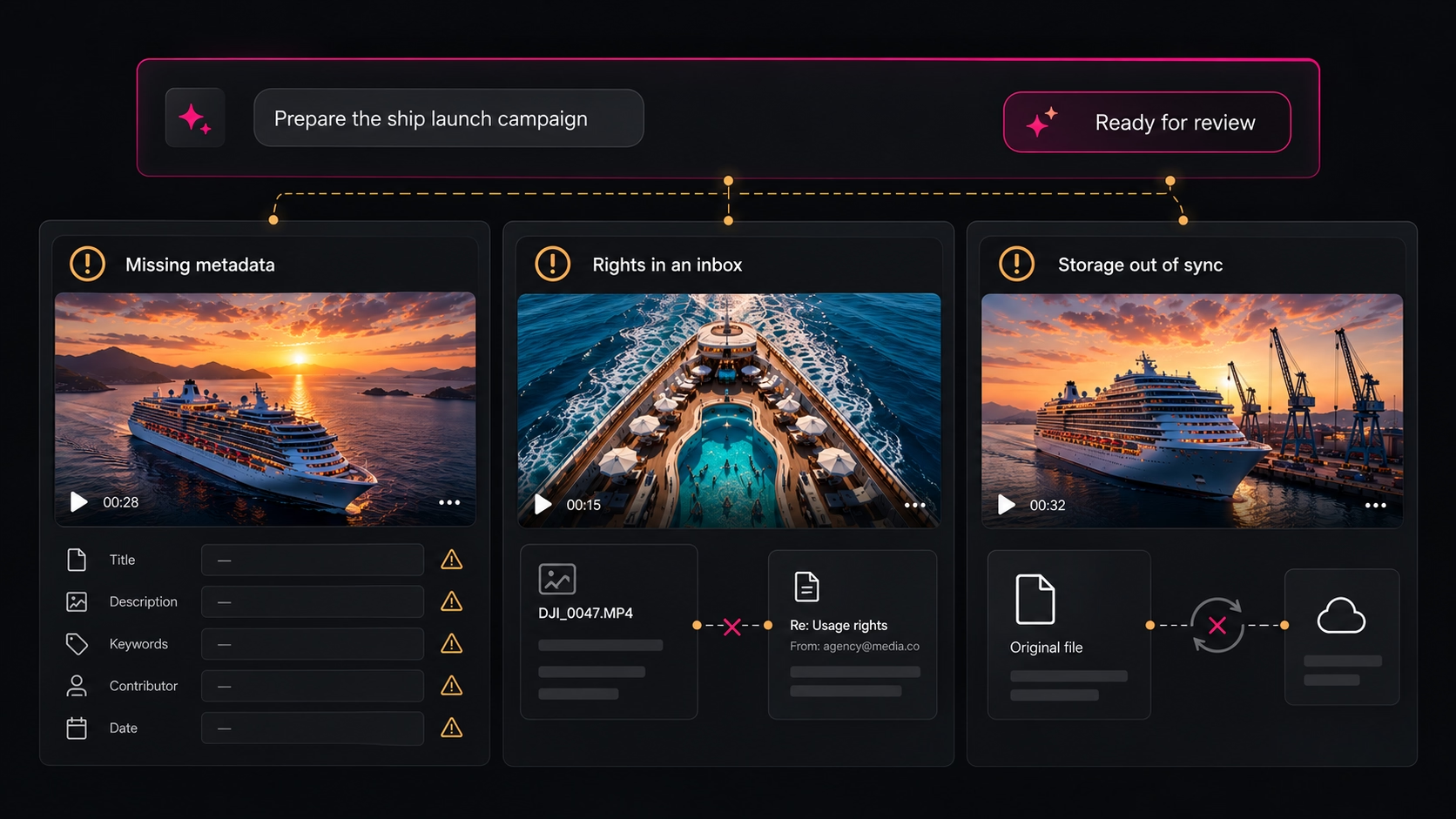
In our world, agent washing means taking a system built for an era when humans kept it honest and putting a chatbot on top. Underneath, the metadata is still patchy, rights still live in someone’s inbox, and the storage has drifted since the last scan. An agent on that foundation acts on bad information, quickly and at scale. That’s not autonomy. It’s automation with a confidence problem.
I think in three eras. The first was file storage: a place to put things. The second was the traditional MAM: a system that needed you, with real structure only if people kept tagging and filing correctly. Critics call it a glorified file system, and for that era I’ll concede the point. The third is the autonomous MAM: a teammate that doesn’t need you to keep it running.
Most of what’s sold as “AI in MAM” today is the second era with better tags and a chat window. The third era is a different category, and the AI has to be in the foundation, not bolted on top.
What autonomous actually means
Strip away the buzzwords and an autonomous MAM does four things.
It doesn’t wait to be told what something is. It looks at the footage, image or document and understands it the way a person would, not by reading a filename.
It doesn’t wait to be asked to organise. By the time you’d think to file or version something, it already has.
It doesn’t wait for you to notice a problem. An expiring licence, a duplicate upload, the wrong version about to ship: it flags them before you’d know to look.
And it gets smarter alongside people, not instead of them. Every correction someone makes teaches it something.
Picture a cruise line’s in-house studio. Drone and deck footage of a new ship lands on Monday from three crews. In the search-first world, it sits there until an editor goes looking. In the autonomous world, it’s checked, understood, versioned and filed by lunchtime. The best shots go to the brand team for review. The ones covered by the shipyard’s embargo are held back automatically. Social cuts and web crops are drafted from the masters. When the music licence on last season’s sizzle reel runs out, the system pulls it from use and suggests three alternatives that look and perform alike. Nobody had to search for anything.
Who stays in charge
The first question I get asked is whether this is safe. Shouldn’t a human decide?
Yes, and they do. Autonomy is a dial, not a switch. At first the system proposes: tags, routes, asset picks, all for a person to approve. As trust builds, it acts within guardrails you set and escalates only the exceptions. You decide where the dial sits for each kind of work. Filing might run on full autonomy from day one. Anything that touches rights might never go past “propose”. Before expanding automation, check whether your media library is ready for AI.
The line I keep coming back to: the AI takes the work, not the job. Tagging, filing, version-chasing and expiry dates are work nobody joined a creative team to do. Taste, storytelling, judgment and client relationships stay human. Technology should multiply human connection, not replace it.
Where we are, honestly
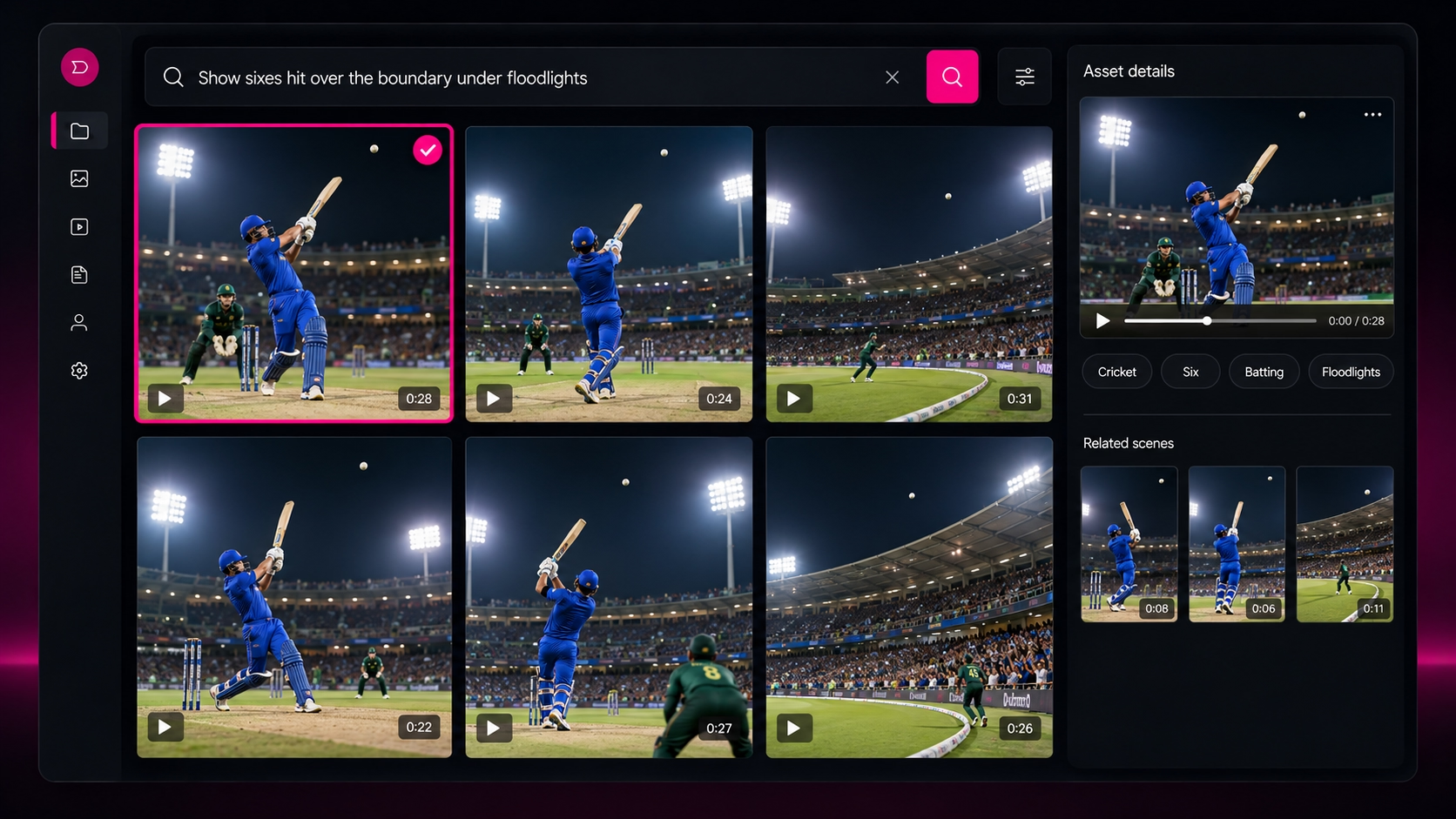
I’d be a hypocrite to write this and then oversell our own product, so here’s where Evolphin X stands.
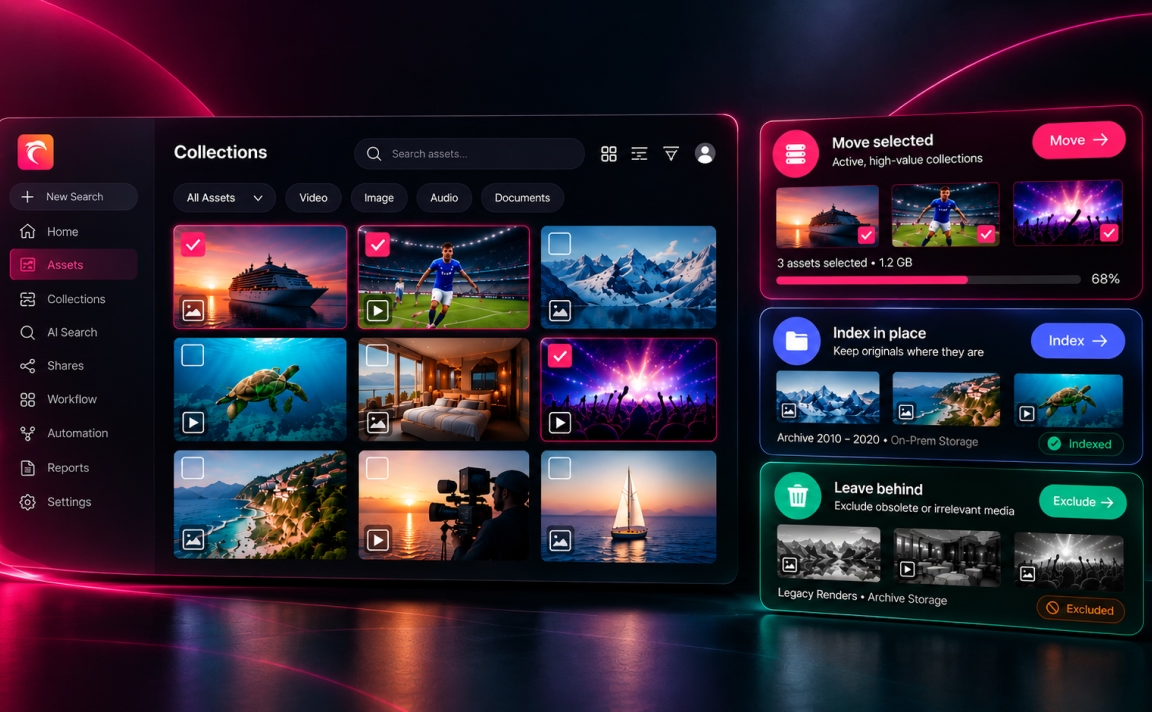
Live in Evolphin X today: Index in Place, so your media stays on storage you own while we index it and keep the record in sync. Moving collections when they genuinely need a new home. An open API. A Crop.photo integration that sends images out for editing and brings the results back into the library, versioned and filed, with nobody chasing them. We also already run scheduled reconciliation that reports missing originals, and warn before bulk AI processing so a big scan never becomes a surprise bill. Both are live, and we’re still improving them.
Over the next twelve months we’re building the rest of what you’ve read here: automatic tiering, rights and expiry enforcement, workflow routing, derivative creation, turning a brief into a shortlist of assets, and learning from every correction. We’re building it on that foundation, not bolting it on.
Five questions for any vendor selling you “AI”
Whoever you talk to, including us, ask:
- What does the system do without being asked?
- What happens when someone moves or deletes a file outside it, and how would I know?
- Does it know whether an asset is cleared to use, or only that it exists?
- Where can I set the dial between “propose” and “act”, and who sees the exceptions?
- What will AI processing cost me, and will I know before I’m billed?
- If the answers all come back to search, you’re looking at the second era with a new coat of paint.
Don’t bring us your hardest search
Every vendor will take that challenge, us included. Bring us the work that happens after the search instead: the approvals you chase, the rights you check by hand, the crops you make for every channel. Let’s talk about which of those your library should be doing for you. Email me at brian@evolphin.com.