Every year, somewhere in a finance review, someone asks the same question about the media asset management system: what does it cost us?
Storage, licences, the admin who keeps it running, the AI bill that came in bigger than expected. Add it up and the MAM sits on the spreadsheet as a cost center.
I think that’s the wrong question. The better one is: what is our media earning us, and what is it failing to earn because nobody can find it?
The short answer: a MAM becomes a profit center when it does three things well. It makes the archive findable without someone having tagged it first. It knows what you are allowed to do with each asset. And it lets you put content in front of the people who will pay for it, or reuse it, without a week of file wrangling. Get those right and the library stops being a storage bill and starts being an inventory you can sell.
Why most MAMs end up as cost centers

Most media libraries were built for retention, not revenue. The brief was “keep it safe and don’t lose it”. So the systems got very good at storing things and quite bad at surfacing them.
Anyone who has worked in a sports club, a broadcaster or a large in-house studio knows the result. Decades of footage sit on drives and tape. A few hundred well-known clips get used over and over because people know where they are. Everything else is effectively invisible.
Invisible content can’t earn, but it still costs money to store, back up and migrate.
There’s a second leak that never shows up as a line item: people’s time. McKinsey’s often-quoted research found knowledge workers spend about 19% of their working hours tracking down information they need. Media teams are no exception, and with video the problem is worse, because you can’t skim a clip the way you skim a document.
To make that concrete, here’s an illustrative example. Take a team of 20 producers, editors and archivists with a fully loaded cost of $90,000 each. If 19% of their time goes on finding things, that’s roughly $342,000 a year spent looking rather than making. Your numbers will differ, but “can’t find it” has a real price, and it’s usually bigger than the MAM licence.
The buyers for your archive have changed

Archive monetization used to mean the occasional documentary request, handled by email and goodwill. That market is still there, and it’s growing. Rights holders like ATP Media and the Pac-12 have signed licensing deals for their archives this year, opening their footage to documentaries, advertising, news and branded content. Leagues are cataloguing behind-the-scenes material, interviews and training footage precisely because buyers keep asking for it.
Then there’s a newer buyer: AI companies. According to Bloomberg, AI firms have been paying between $1 and $4 per minute for unpublished video to train their models, with higher rates for premium material. Data brokers have quoted $100 to $300 per hour for longer-form film. These deals are early, prices vary widely, the legal landscape is still settling, and you should never license anything you don’t clearly hold the rights to. But it’s a real signal: footage that sat unused for years now has a price.
Here’s the catch. Every one of those buyers needs the right material found fast, proof you hold the rights, and clean delivery. That’s exactly the job of a MAM, which is why the MAM, not the storage, is where the money is made or lost.
Cost center vs profit center: what actually changes
A four-stage model: Find, Clear, Package, Earn
When I talk to customers about this, I use a simple model. Every asset that earns money has gone through four stages. If any one of them breaks, the revenue doesn’t happen.
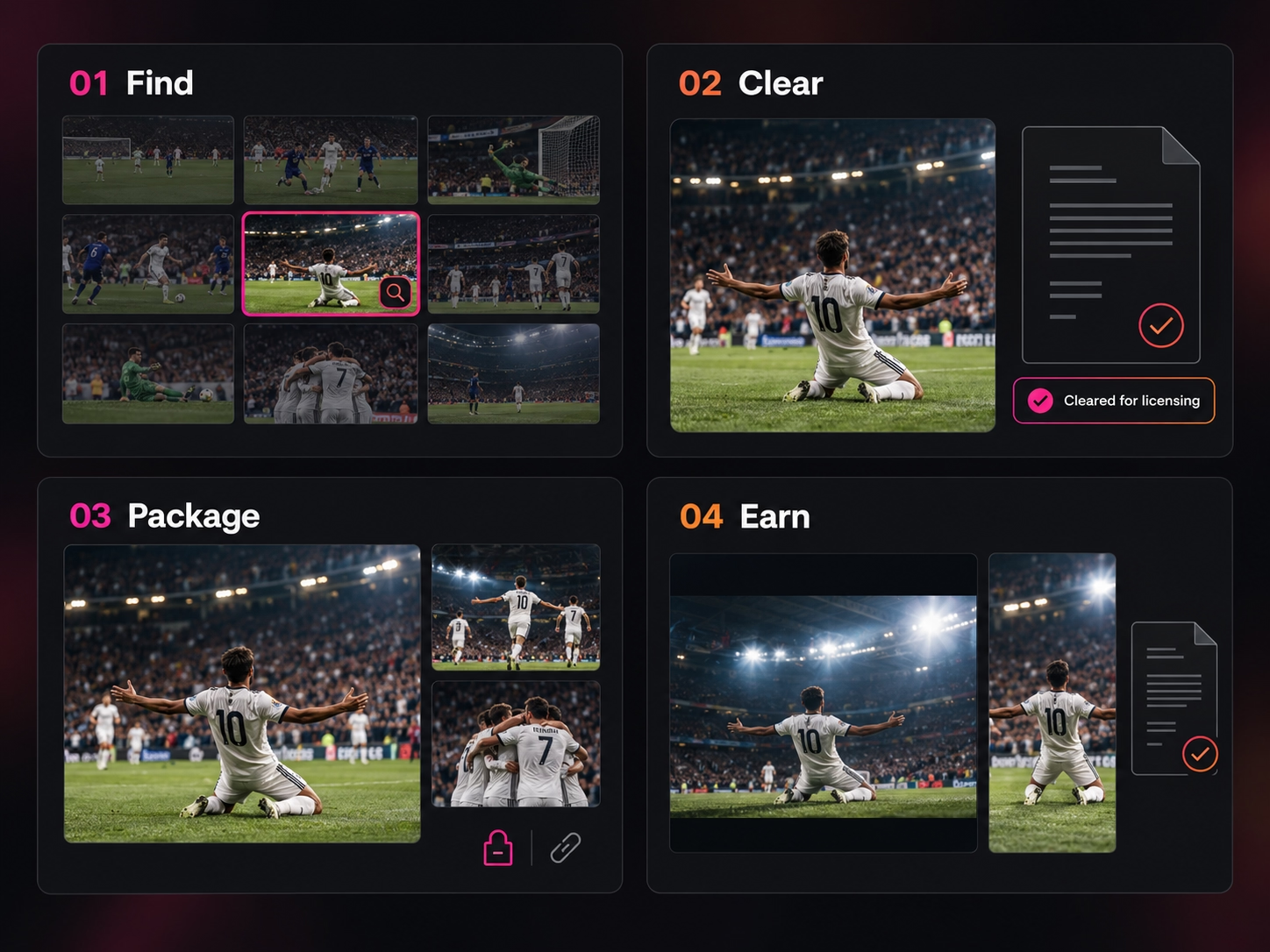
1. Find
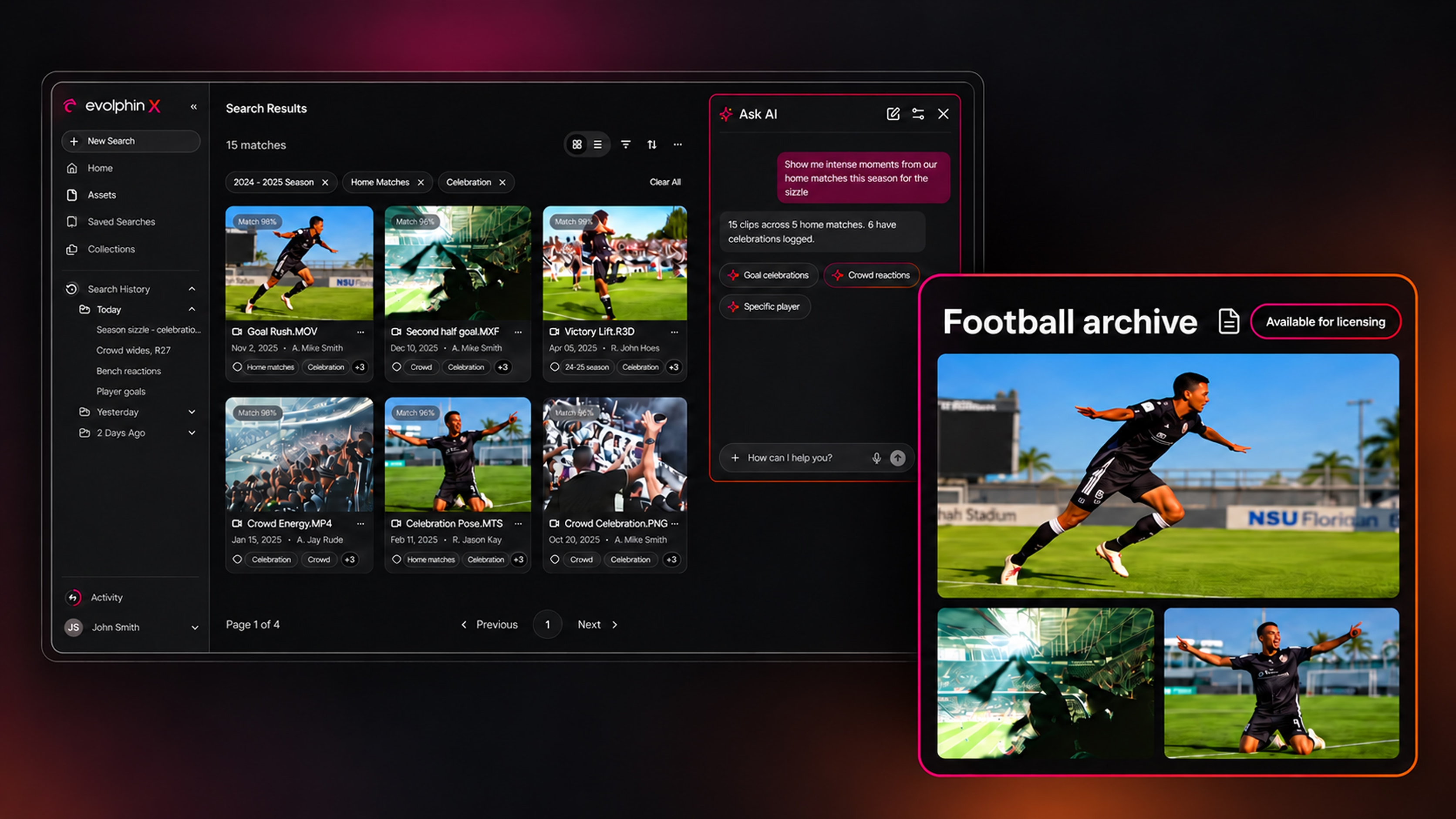
You can’t sell what you can’t find. This is where AI changes the economics. Instead of relying on an archivist to have logged every shot in 2009, AI can index what’s actually in the footage: people, places, actions, spoken words, on-screen text.
See how different platforms handle AI search for media assets, using real footage and search tasks.
But indexing everything is expensive, and a lot of any archive isn’t worth the compute. So grade the library first. A-tier is hero content with clear commercial value: the championship seasons, the iconic interviews, the behind-the-scenes footage people keep asking for. B-tier is solid but niche. C-tier is archive you keep for the record. Index and promote the A-tier now, the B-tier as demand shows up, and leave the forty takes of a sponsor logo alone until someone asks.
Before processing a collection, check whether your media library is ready for AI.
2. Clear
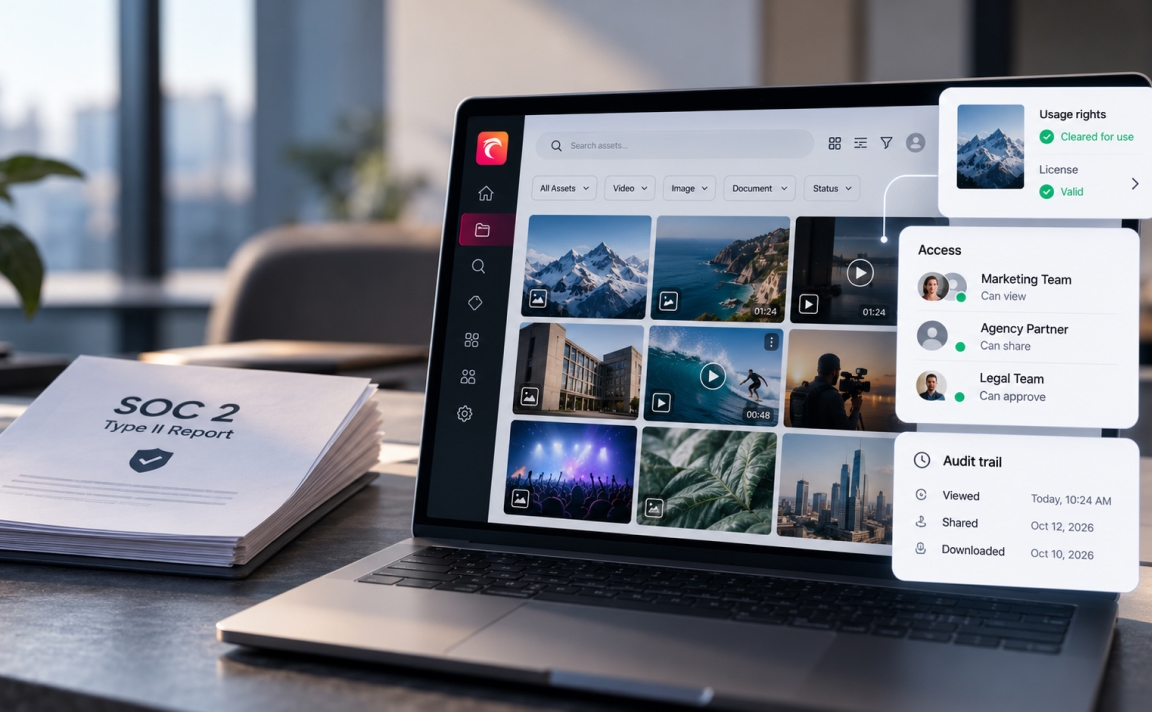
The fastest way to turn a revenue opportunity into a legal problem is to license something you don’t own. Music beds, player image rights, third-party footage, territory restrictions, embargoes. Rights information has to live with the asset, not in a contract folder three systems away.
The simplest version is a clearance status on every asset: fully cleared, editorial only, or restricted. Editorial-only material can still earn from news, documentaries and education, it just can’t go into an advert. Keeping the two separated is what lets you say yes quickly without saying yes to the wrong thing.
This is also where the human stays firmly in charge. AI can flag a likely music cue or a face it recognises. A person decides what’s cleared.
3. Package
Buyers don’t want your raw drive. They want a curated set of clips, with proxies to preview, metadata they can trust, and a simple way to request the master. A sponsor wants their season’s activations in one place. A documentary team wants every clip of a particular player from a particular decade.
Packaging is where most organisations still lose days to exporting, renaming and emailing links. A MAM that lets you assemble a collection and share it securely, with the right permissions and without moving the masters around, turns that from a project into a task.
4. Earn
Earning isn’t only licensing fees. It’s also the reshoot you didn’t have to commission because the footage already existed. The social clip that went out the same afternoon instead of next week. The sponsor renewal that was easier because you showed them everything their partnership delivered. Reuse is revenue too, it just shows up as cost you didn’t spend.
For external sales, you have a choice of channel. Third-party marketplaces get you in front of buyers quickly but take a large share and keep the customer relationship. Your own portal keeps the margin and the relationship, but you have to bring the buyers. If your MAM can take the licence and the payment itself, that portal doesn’t have to be a separate build. Most serious licensing operations end up doing both: marketplaces for reach and volume, a direct channel for premium content and repeat buyers.
And if you’ll never sell a frame externally, you can still run the MAM like a profit center. Attribute its costs to the teams that use it, and tie usage to outcomes: the campaign that reused archive instead of shooting new, the duplicate purchases that stopped. That turns “what does it cost?” into “what did it save, and for whom?”
What a profit-center MAM looks like in practice
Picture a football club with a century of history. Inter Milan, an Evolphin customer, manages more than 113 years of media. Every anniversary, documentary, kit launch and sponsor activation draws on it.
A request comes in from a production company: all footage of a particular derby across three decades, preview by Friday. In a cost-center setup, that’s an archivist’s week, a pile of drives and a lot of guesswork about rights. In a profit-center setup, someone searches for what they need in plain language, filters to material that’s cleared for third-party use, drops the results into a collection, and shares a secure portal link the producer can review the same day. When the producer has chosen their clips, they accept the licence terms and pay in the same portal, and the masters are delivered. Nothing leaves the club’s storage until the deal is done.
Same footage. Very different economics.
Where Evolphin X fits
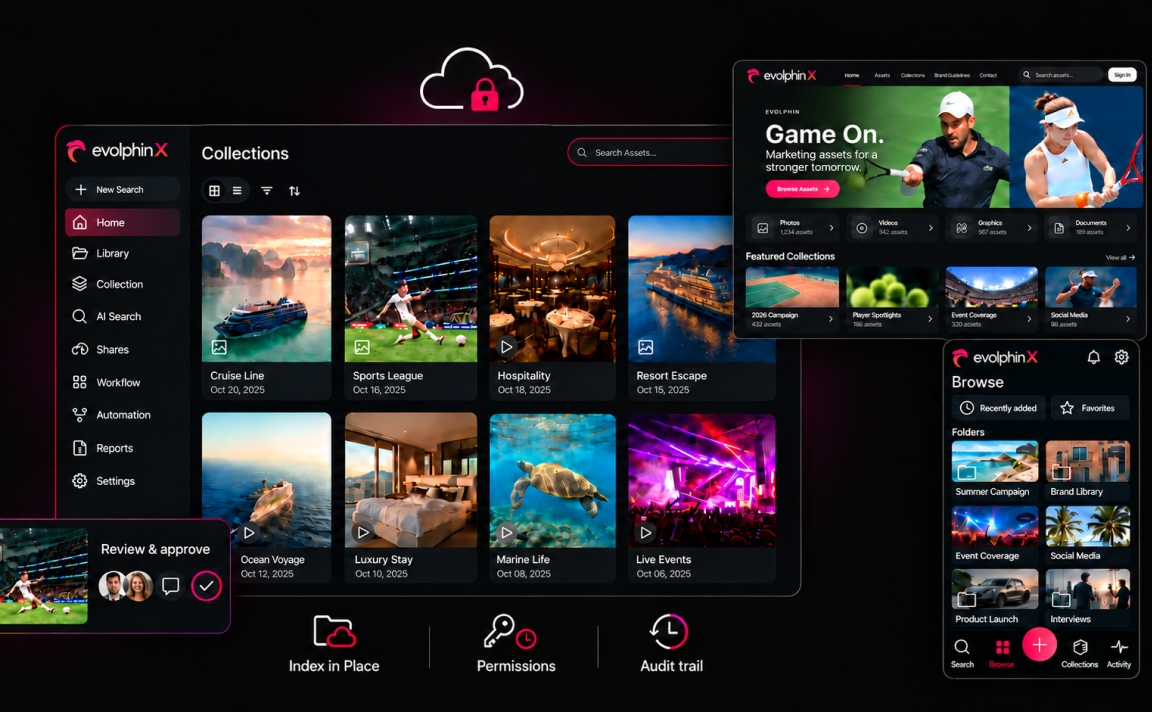
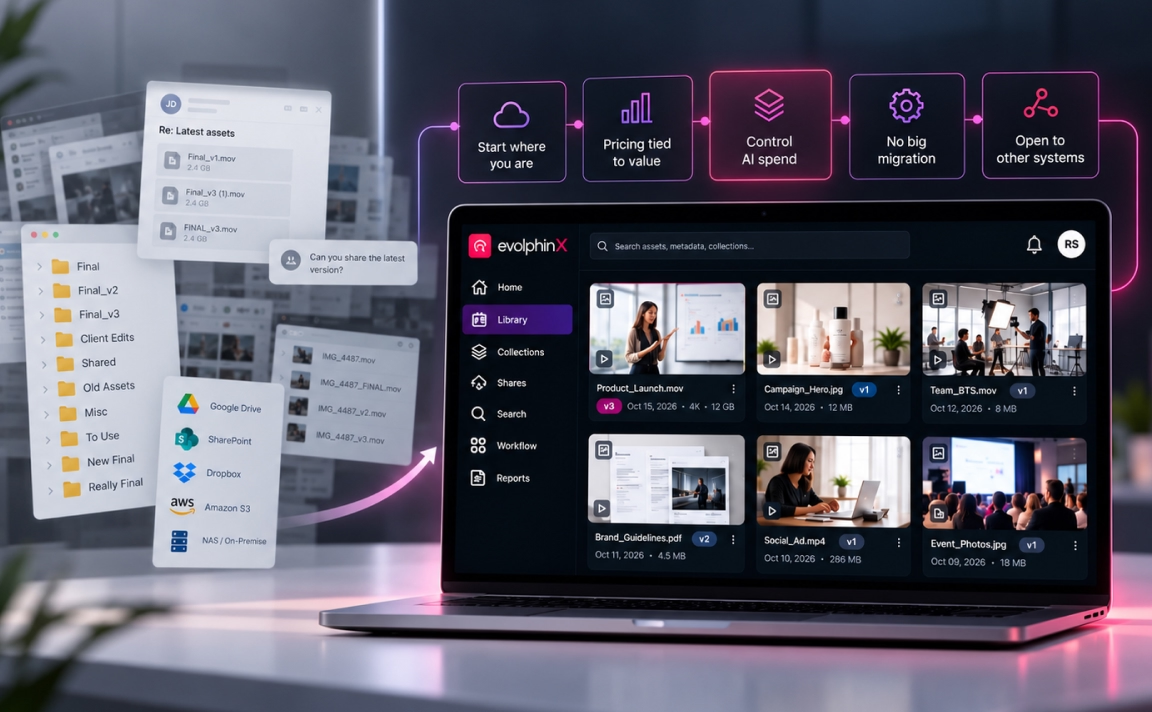
We built Evolphin X media asset management to help teams get more value from the media they already own. Index in Place lets you keep your media on the storage you already own while we manage the AI indexing and keep everything in sync, so you’re not paying to move a library before it can earn anything. Selective AI indexing means you choose what gets indexed, by file, by file type or by any subset, rather than paying for everything or nothing. The Collaboration module, which launched on 1 October, gives you secure collections to share content with internal teams and partners; in Q1 we will release our Portal which will let you sell your content. A buyer will be able to open a portal, pick the clips they want, pay or accept the licence terms right there, and receive the master files. No separate storefront, no chasing invoices for a single clip. And the open Core API means your existing rights or finance systems can plug straight in.
Over the next six months, we will deliver Portals, Mobile Apps, extensive Plugins, and we’re also delivering self-provisioning, so you’ll be able to switch on new modules from our website as and when you need them.
A checklist for your next budget meeting
Before anyone asks what the MAM costs, ask these:
• What share of our archive could we find in under five minutes today?
• Which parts of the library have commercial value, and are those indexed?
• Do we know the rights status of our most-requested footage without opening a contract?
• How long does it take to put a curated package in front of an external buyer?
• How many licensing, sponsor or reuse requests did we turn down or never answer last year?
• Are we paying to index, move or store content that will never earn anything?
• Does our team use the MAM willingly, or do they work around it with shared drives?
That last one matters more than people think. A library only earns if people use it, and they only use systems that make their day easier. Use these outcomes when defining your media asset management requirements, so the evaluation starts with business value.
The library is an asset. Treat it like one.
Every media organisation I talk to says its archive is priceless. Very few can tell me what it earned last year.
That gap is the opportunity. The footage already exists. The buyers are already asking. What’s usually missing is a system that makes the archive findable, clear and easy to share. Fix that, and the conversation in the finance review changes from “what does this cost us?” to “what else can it do?”
If you want to talk through what that could look like for your library, I’d genuinely like to hear from you.